What It Does
The Burnout Risk Model is a composite scoring system that quantifies “hidden” employee stress factors. It aggregates distinct data points—such as commute distance, overtime hours, and promotion stagnation—into a single 0-100 “Burnout Score” for every employee.
The Problem It Solves
Burnout is often treated as a qualitative feeling, leaving HR leaders reactive rather than proactive. By the time an employee reports feeling burnt out in a survey, they are often already looking for a new job.
How It Works
I engineered a Composite Risk Score using Python (Pandas) to weigh and aggregate stressors found in the IBM HR dataset. The model assigns weighted points to risk factors:
- Overtime (+30 pts)
- Commute (>20 miles) (+20 pts)
- Stagnation (No promotion >4 years) (+10 pts)
- Sentiment (Low Work-Life Balance score) (+40 pts)
Key Features
- Weighted Scoring Algorithm: Differentiates between minor irritants and major flight risks.
- Risk Segmentation: Automatically categorizes the workforce into “Safe,” “At Risk,” and “Critical” cohorts.
- Visual Impact: Generates clear distribution charts to highlight organizational hotspots.
Results / Impact
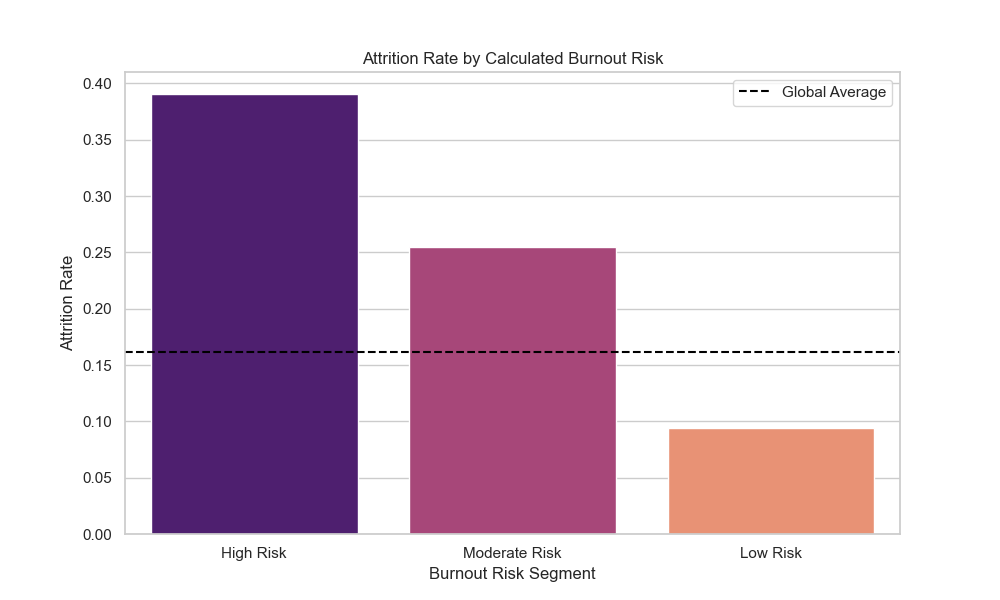
The model successfully identified a “Red Zone” cohort of 64 employees who were 4x more likely to resign (39.1% attrition rate) compared to the low-risk group (9.4%). This allowed HR to deploy targeted retention interventions before resignations occurred.
Tech Stack
| Layer | Technology |
|---|---|
| Analysis | Python (Pandas / NumPy) |
| Visualization | Matplotlib / Seaborn |
| Data Source | IBM HR Analytics Dataset |